
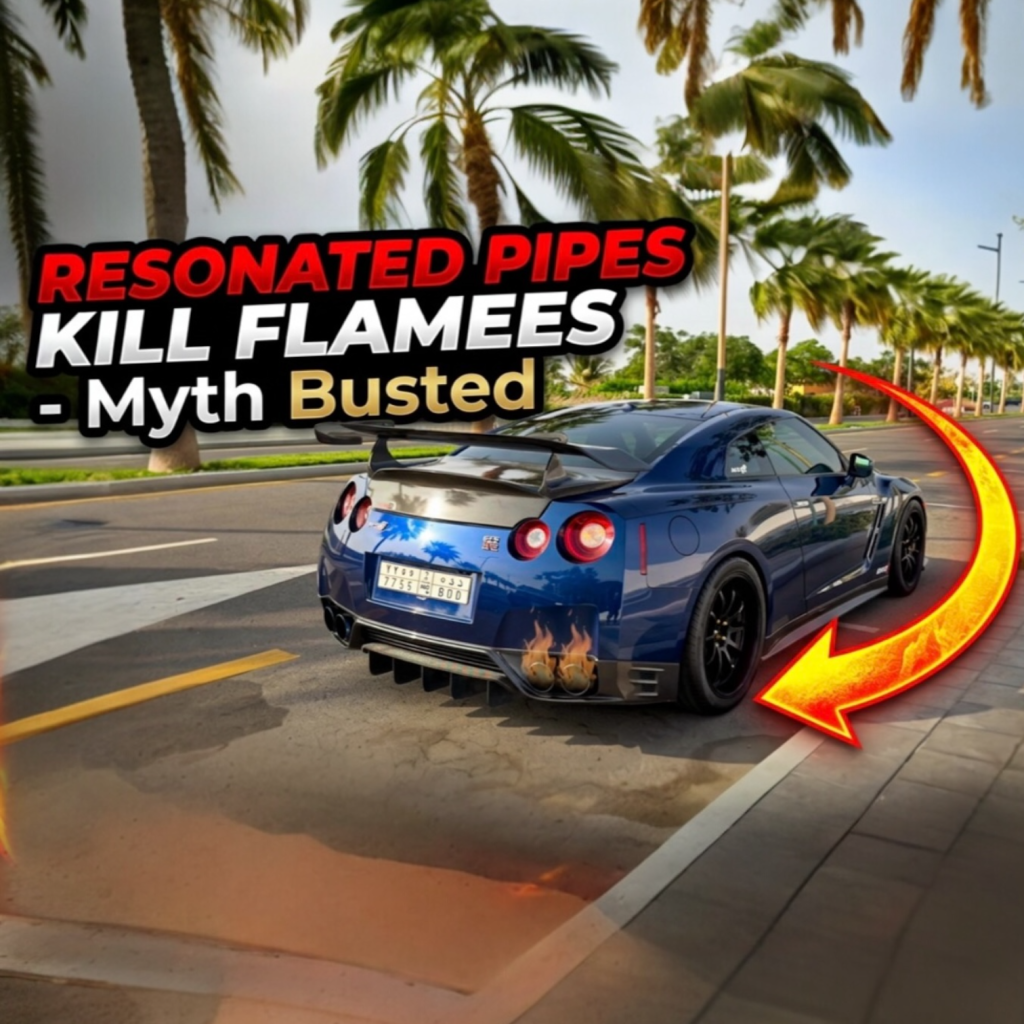
Let me clear something up that I keep seeing argued wrong online.
People love to say that having a resonated midpipe on the R35 GT-R kills any chance of getting exhaust flames. The logic sounds reasonable on the surface, a resonator dampens exhaust pulses, so surely it softens everything, including any unburned fuel igniting at the tip. Right?
Wrong. Mine does it regularly. And there’s a proper engineering reason why.
My Exhaust Setup for Context
Here’s what I’m running:
- Downpipes: Alpha 90mm catless downpipes
- Midpipe: HKS 85mm resonated midpipe
- Exhaust: HKS Legamax cat-back
- Tune: ECUTek, running modified custom maps. And no! No pop bangs
The car is a built Alpha 9 setup. It is not stock in any meaningful way. That context matters a lot for this conversation. But even back at FBO level, it still shot flames.
Exhaust Sound Review
Shooting Flames
follow my new channel (here), closing the old one soon.
When It Happens
The flames show up in specific, repeatable conditions:
- Car is fully heat-soaked. coolant and oil temps at operating range
- Hard acceleration under load, full-throttle pulls.
- Sudden throttle lift, or a quick blip of the throttle after a lift
It’s not the cheap, programmed pop-bang nonsense you see on Instagram where someone’s paid for an anti-lag or overrun map that forces the car to misfire on demand. This is the car doing what the physics dictate. There’s a difference, and it matters.
The Actual Mechanics — Why This Happens
1. Unburned Fuel in the Exhaust Stream
Under hard boost, a modified and tuned GT-R runs a richer air/fuel mixture than factory. This is intentional, running rich (10-11) under load is a safety buffer against detonation, especially on a high-boost setup. The byproduct is that some unburned or partially burned fuel makes it past the combustion chamber and into the exhaust stream.
When you lift off the throttle abruptly, the fuel delivery doesn’t cut off instantaneously. There’s a brief overlap where residual fuel is still present in the exhaust gas. That fuel-rich exhaust exits the system hot enough and with enough oxygen exposure at the tip to ignite.
2. Catless Downpipes Are a Major Contributor
This is the part most people undervalue. The catalytic converter isn’t just an emissions device, it’s a chemical reactor that burns off hydrocarbons (unburned fuel) as exhaust gases pass through it. A stock or high-flow catted setup oxidizes a significant portion of that unburned fuel before it ever reaches the midpipe or cat-back.
Any catless downpipes eliminate that process entirely. Unburned hydrocarbons travel the full exhaust path completely unoxidized. By the time they reach the exhaust tip, they’re still combustible, and if temperature and oxygen conditions are right, they ignite visibly.
3. So What Does the Resonator Actually Do?
A resonator (HKS or otherwise) works acoustically, not chemically. Its job is to cancel specific sound frequencies by creating a chamber where opposing sound waves interfere with each other. It reduces drone and harshness in the exhaust note without significantly altering exhaust flow velocity or backpressure in the way a muffler or catalytic converter does.
Critically: a resonator does not oxidize, absorb, or destroy unburned fuel molecules. It is not a combustion device. It does not chemically interact with what’s flowing through it. The hydrocarbons that enter the resonator exit the resonator, because the resonator has no mechanism to do anything to them.
This is where the “resonated pipe = no flames” myth falls apart. People are conflating acoustic dampening with fuel treatment. They’re completely different functions.
4. Temperature and Timing at the Tip
For combustion to occur at the exhaust tip, you need three things simultaneously: fuel (unburned hydrocarbons), oxygen (ambient air meeting the exhaust stream), and heat (the exhaust gases and hot metal surface provide this).
A heat-soaked car on a hard run has exhaust gas temperatures that are significantly elevated. The tip itself is hot. When a quick throttle blip or lift introduces a pulse of fuel-rich exhaust into ambient air at the tip, the ignition conditions are satisfied. The result is a visible flame event brief, sharp, and proportional to the richness of the mixture and the exhaust gas temperature at that moment.
The resonator, sitting upstream in the system, has no bearing on whether those three conditions exist at the tip.
Why the Myth Persists
Probably because most people discussing this are running stock or mildly modified cars with cats intact. On a catted setup, the converter is doing exactly what it’s designed to do, burning off unburned fuel before it exits. If you add a resonated midpipe to a catted car, you’re unlikely to see flames, and the resonator gets the credit for suppressing them. But the cat did the actual work.
Strip the cats out, run a proper tune with modified fuel maps, and the resonator’s acoustic function becomes irrelevant to whether you see combustion at the tip. The chemistry changed; the resonator didn’t.
What This Isn’t
To be clear, I’m not running a pop-bang map. There’s no overrun fueling strategy in my ECUTek tune designed to force misfires for the spectacle. What I’m describing is a byproduct of legitimate, track-oriented modifications: catless downpipes eliminating hydrocarbon oxidation, a tune that prioritizes engine safety with a slightly richer mixture under load, and a high-flow system that preserves exhaust gas energy all the way to the tip.
The flames are a symptom of the build, not a feature I dialed in for show.
Find out more about my GT-R Build
 MAJJ GARAGE
Leave a comment